
Geometric frustration

Geometric frustration occurs when local interactions have preferred configurations, but the geometry of the system means that there is no collective configuration in which each interaction is at its preferred state. For example, suppose that a component can occupy one of two states, 1 or -1, and it always wants to be at the opposite state of its neighbor—so if it is connected to a component that is at 1, it wants to be at -1. Then some geometries, like two components connected by a single line, or four components in a square with no diagonal connections, allow all interactions to be satisfied. However, three components arranged in a triangle are geometrically frustrated because the geometry of the triangle makes it impossible to satisfy all interactions: if the component at vertex A of the triangle is at 1, then the component at vertex B has to be at -1, but then the component at vertex C doesn’t have a way of eliminating a frustrated interaction: it needs to be at -1 to be opposite A but needs to be at 1 to be opposite B.
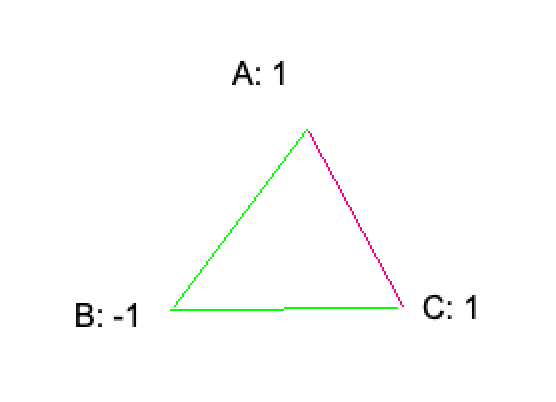
The problem isn’t with the component at vertex C but rather the arrangement of the system: satisfying the A-C relationship by flipping the value at either A or C means dissatisfying either the A-B or B-C relationship. This shows something important about geometric frustration: a component can move the frustration by changing its own state, but it cannot eliminate it because satisfying one previously unsatisfied interaction necessarily frustrates another. So geometric frustration has important implications for the development of collective systems because by definition, the problems implied by the current organization of the system cannot be eliminated by the adjustment of an individual component’s relationships within that component’s set of feasible alternatives. Instead, to make all interactions optimal simultaneously, the feasible set has to be changed—e.g., by adding a fourth component at a fourth vertex so that a square can be arranged instead of a triangle.
Geometric frustration may sound bad, but, like prestress, it can actually be very useful. In an unfrustrated system, all the local interactions can be satisfied at once. As a result, there is nothing to negotiate from a certain perspective: the best global arrangement is simply the one where each interaction is satisfied. Finding that configuration may not be easy, but the system doesn’t have to decide which relational requirement will be sacrificed.
But in a frustrated system, at least one interaction must be some distance from its preferred state. This means the question isn’t whether the system can be satisfied but where it should be dissatisfied—an allocation problem. When there are several distribution options, as there are in the above triangle example—you can pick which interaction, A-B, B-C, or A-C, will be unsatisfied—then the system has to make choices, and those choices are nontrivial because the state of each component depends on how the system as a whole is accommodating its frustrated interactions.
This helps to enable the construction of interesting cognitive behaviors in material systems. Systems with geometric frustration can exhibit memory and be trained to reproduce certain microstates. It can even be exploited to program different collective modes of behavior in materials.
Prestress can also help enable cognitive properties in mechanical systems. While prestress and geometric frustration are different things, they both describe some sense in which the elements of the system are having trouble being totally comfortable with respect to each other. This may suggest a broader principle: getting collective systems to exhibit interesting properties is about organizing conflict instead of eliminating it.