
Categorization in purely mechanical structures via prestress as a cognitive glue

Tensegrity structures have some fascinating and counterintuitive visual and behavioral properties. Visually, they are able to hold themselves up in a self-maintaining equilibrium; they do not depend on their own weight, on gravity, or on an anchor or external support or surface. Behaviorally, the system exhibits collective behavior; the components are induced to behave in a cooperative manner for a system-level goal despite the fact that the system is purely mechanical with no evident brain-like organ.
Both of these remarkable properties are due to the prestress over the whole organization, where because the cables pull on the struts and the struts tense the cables, the whole system is pushing and pulling on itself before anything happens to it. It’s like pulling a rubber band between your hands: the system is in equilibrium, but it’s also a system that’s highly ready to move if anything changes. Neither the rubber band nor your hands are entirely comfortable; the balance of the hands-band system is a balance of the frustrations between the components. As a result, a prestressed system isn’t simply reactive but ready: it is globally prepared to make meaning of local events.
Due to prestress, when a tensegrity structure is just sitting there doing nothing, it isn’t really doing nothing. The cables are all under tension; the struts are all actively being compressed. Each component is trying to relax, but they can’t because of the way they all mutually constrain each other. The balance of competing demands produces a self-equilibrating structure that collectively responds to local events.
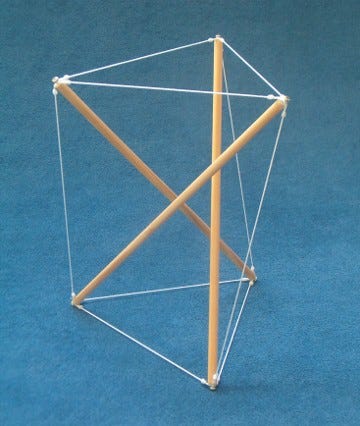
The prestressed organization creates an attractor network: here’s the configurations that work, so when perturbations move the system away from one of those configurations, the system self-organizes back to one. This enables the system to engage in one-shot categorization. When a novel perturbation disturbs the system—someone pokes it, say—the system doesn’t need to compare the perturbation to a database of 10,000 previous pokes. Instead, the force simply enters the already-coupled system; the changing stress signals throughout the system induce individual struts and cables to stretch or shift in appropriate ways, and the system reorganizes to a stable configuration. The system doesn’t care about individual differences in pokes except insofar as they matter for the reorganization process, thereby treating pokes that differ in causal history or in reorganizationally insignificant ways (e.g., some microscopic difference in the forces) as equivalent, i.e., it categorizes the events. The collective organization of the system forces diverse perturbations to converge onto a smaller set of dynamically stable responses. That’s categorization.
(A multistable organization might then be able to choose how to categorize events.)
One-shot categorization of this kind is enabled by a cognitive glue that makes local events globally meaningful, and global preferences (a virtual governor) locally actionable. Prestress achieves this: because the system is already this careful balance of competing demands that mutually constrain each other, a poke to one part of the system forces a global renegotiation of the force balance. So instead of the perturbation encountering some blank possibility space, the forces are integrated into a structured repertoire of responses. The response space is organized prior to the perturbations that require responses!
Prestress thus exhibits the properties of a cognitive glue. Prestress even enables a basic kind of experimentation capability: if you place the tensegrity structure in some configuration and release it, its own dynamics will determine whether that configuration is stable. Changing the prestress even changes how the system categorizes!
While tensegrity structures can categorize events, it is not obvious that they can learn about them. To learn, the system needs to be able to form a memory when perturbed: the system’s attractor landscape needs to transform with respect to the perturbation such that subsequent perturbations of the same type produce different effects than the first one did. There are at least nontrivial examples in mechanical systems of memory, such as shakedown.
My suspicion, therefore, is that categorization is an extremely basic property fundamental to memory, learning, and intelligence in general. Categorization requires a cognitive glue born of the shared constraints between the components of a system that structures the behavior of the system so that different events are treated as the same for some purpose.
Recently, Lisa Feldman Barrett and Earl Miller recently published a paper arguing that categorization is “baked” into the brain: rather than being an endpoint of an intelligent process, categorization is something that happens all throughout the brain’s activity. Tensegrity, via prestress, may show that categorization is baked into mechanical self-organization: any system that self-organizes via a shared constraint network necessarily categorizes some class(es) of events. Learning and memory may be some kind of second-order effect of categorization where the attractor landscape isn’t just ready for perturbations but also responsive to them.
"Primitive categories via inherent categorization" reads like a response to the symbol grounding problem.